Whatsapp is a standout amongst the most well known cross stage informing applications for ios and something that I utilize every day on my iphone to stay in contact with loved ones. The application has been accepting new gimmicks routinely, however despite everything i'm baffled that the designers haven't added local Quick Reply to it yet.
In case you're an escape client, you'll be happy to get some answers concerning a change known as Nuntius that guarantees to bring this peculiarity to Whatsapp. With the change introduced, you can without much of a stretch react to Whatsapp messages from the Notification flag, regardless of whether you're inside the application or not.
When you get a message from Whatsapp, essentially swipe down the Notification Banner and a content field shows up where you can sort in your answer and send it immediately without opening the application. Alongside individual discussions, the change backings gathering messages also.
In the wake of introducing Nuntius, there are no settings to arrange. Basically swipe down the warning flag from Whatsapp and react to the messages from anyplace in ios.
As quite a while and regular client of Whatsapp, I've been enthusiastically sitting tight for a change like this which brings Quick Reply to the informing application and I can say that Nuntius does its employment flawlessly. It doesn't make any issues and works splendidly as promoted.
The change is at present in beta and may have a few bugs, yet in the event that you'd like to get your active it, you'll need to add another source to Cydia. To do thus, dispatch Cydia and head to Sources -> Edit -> Add and sort in the accompanying URL: http://sharedroutine.com/repo/. Once done, just look for the change in Cydia and search it.
Showing posts with label IPhone. Show all posts
Thursday, 29 January 2015
Tuesday, 27 January 2015
‘Alfred Remote’ can make your iOS device a remote control for your Mac
On Tuesday, January 27, Running with Crayons authoritatively proclaimed an extend a long-term impending: Alfred for ios.
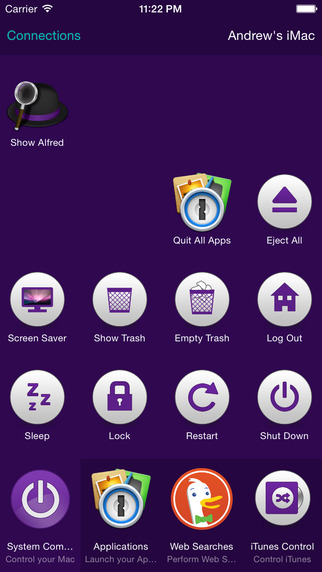
The application, which is presently accessible in the ios App Store for $4.99, is planned with some equality with the "Alfred" Mac application. The thought behind the ios application is to capacity as a remote control for your Mac, making it conceivable to control certain components of the machine, such as opening a few applications, right from your ios gadget.
More than that, however, the Alfred for ios application will let clients get to some systemwide associations on their machine, as well. That will take the expansion of a Powerpack alongside Alfred 2 on their Mac, which costs around $25. With this expansion, Alfred for ios clients can control some selective parts of the framework, including itunes playback.
Different gimmicks included with the Powerpack alternative incorporate the capacity to duplicate and glue from ios to OS X, running terminal orders, and actually making and altering custom Workflows.
For clients who would prefer not to spend additional for the Powerpack alternative, Alfred for ios will let clients actuate a screen saver or open pages on their Mac from their iphone or ipad.
With a solitary touch on your ios gadget, you can control numerous Alfred 2 activities on your Mac, including:
– Show Alfred 2 on your Mac
– System Commands: Lock, restart, close down, log out or rest your Mac, discharge all gadgets, quit all applications and unfilled junk
– Launch Applications and System Preferences on your Mac
– Open records and envelopes you've characterized on your Mac
– Open sites and bookmarks, or pop up Alfred with a custom hunt filled in
– Replace hard to recollect hotkey blends and watchwords with symbols on ios
In case you're an Alfred 2 Powerpack client, you can control Powerpack gimmicks, for example,
– itunes on your Mac: Play, skip, rate your tracks and even begin playing irregular collections
– Quickly glue client characterized clipboard bits into content fields and reports on your Mac
– Run client characterized scripts, Applescripts and terminal summons
– Connecting Remote to your most loved Alfred 2 Workflows gives very nearly boundless conceivable outcomes!
The application is accessible now in the ios App Store, with a download connection to the application underneath
Download Link
The application, which is presently accessible in the ios App Store for $4.99, is planned with some equality with the "Alfred" Mac application. The thought behind the ios application is to capacity as a remote control for your Mac, making it conceivable to control certain components of the machine, such as opening a few applications, right from your ios gadget.
More than that, however, the Alfred for ios application will let clients get to some systemwide associations on their machine, as well. That will take the expansion of a Powerpack alongside Alfred 2 on their Mac, which costs around $25. With this expansion, Alfred for ios clients can control some selective parts of the framework, including itunes playback.
Different gimmicks included with the Powerpack alternative incorporate the capacity to duplicate and glue from ios to OS X, running terminal orders, and actually making and altering custom Workflows.
For clients who would prefer not to spend additional for the Powerpack alternative, Alfred for ios will let clients actuate a screen saver or open pages on their Mac from their iphone or ipad.
With a solitary touch on your ios gadget, you can control numerous Alfred 2 activities on your Mac, including:
– Show Alfred 2 on your Mac
– System Commands: Lock, restart, close down, log out or rest your Mac, discharge all gadgets, quit all applications and unfilled junk
– Launch Applications and System Preferences on your Mac
– Open records and envelopes you've characterized on your Mac
– Open sites and bookmarks, or pop up Alfred with a custom hunt filled in
– Replace hard to recollect hotkey blends and watchwords with symbols on ios
In case you're an Alfred 2 Powerpack client, you can control Powerpack gimmicks, for example,
– itunes on your Mac: Play, skip, rate your tracks and even begin playing irregular collections
– Quickly glue client characterized clipboard bits into content fields and reports on your Mac
– Run client characterized scripts, Applescripts and terminal summons
– Connecting Remote to your most loved Alfred 2 Workflows gives very nearly boundless conceivable outcomes!
The application is accessible now in the ios App Store, with a download connection to the application underneath
Download Link
Friday, 29 August 2014
AdThief' Chinese Malware Infects Over 75,000 Jailbroken iOS devices
If you
have jailbroken your iPhone, iPad, or iPod touch and have downloaded
pirated tweaks from pirated repositories, then you may be infected by “AdThief” malware, a Chinese malware that is now installed on more than 75,000 iPhone devices.
According to a recent research paper published on Virus Bulletin by the Security Researcher Axelle Apvrille, the malware, also known as "spad," was first discovered by security researcher Claud Xiao in March this year.
Till now, AdThief aka Spad malware has hijacked an estimated 22 million
advertisements and stealing revenue from developers on the iOS jailbreak
community, Axelle Apvrille says.
The malware allegedly infects iOS jailbroken devices by disguising
itself as Cydia Substrate extension, presents only on jailbroken Apple
devices, when a malware infected Cydia package is downloaded and
installed by the unsuspecting user.
Once installed, the malware modifies certain advertisements displayed on
your iOS devices in an effort to redirect all the revenues to malware
developer. In short, if you download or install a free ad-supported iOS
app from the App Store, all of the cash generated by that app goes to
the cyber criminal behind AdThief rather than the app’s developer.
"In other words, each time you view
or click an ad on an infected device, the corresponding revenue goes to
the attacker, and not to the developer or the legitimate affiliate," Apvrille said. "[AdThief] hooks various advertisement functions and modifies the developer ID (promotion ID) to match that of the attacker."
Adthief has targeted advertisements from 15 popular mobile advertising
networks, including Google’s AdMob and Mobile Ads, AdWhirl, MdotM, and
MobClick, four of which were based in the US, two in India and the
remainder in China.
The security researcher was able to identify the targets because the
hacker mistakenly forgot to remove identifying information from the
code. Further investigation allowed Apvrille to identify the coder who
ran a blog providing details of various Android hacks, a Github and
inactive Twitter account. Researcher located a Chinese vxer Rover 12421
who admitted writing the AdThief code but denied propagating it.
According to the researcher, the number of infected devices by the
malware is small if compared to the figure of iOS devices in use,
attackers likely generated significant revenue with an estimated 22
million advertisements hijacked.
The most important thing about this particular hack is that there is no
way to find out if your device is infected by AdThief malware, because
it runs in the background and is almost impossible to detect. Users of
unmodified iOS devices need not to worry as they are safe from this
malware infection.
Users of jailbroken Apple iOS devices are recommended to avoid downloads
from untrusted repositories. Always be careful about adding new
sources, and also be suspicious of those sources that promise pirated
downloads of paid apps or tweaks.
Thursday, 28 August 2014
How to Jailbreak iOS 7.1-7.1.x with Pangu 1.2.1 (Updated for Jailbreak Issues)
Pangu jailbreak for iOS 7.x has been updated to 1.2.1 for Windows
with a few bug fixes. If you haven’t jailbroken your iPhone or are
facing issues with a jailbroken iPhone, here’s your chance to
jailbreak/re-jailbreak with the latest version of Pangu.
The new update comes almost right after Pangu v1.2 came out about a few days back. Both 1.2 and this one have minor changes but an important one if you’ve been having problems with boot or anything else on your iPhone.
Jailbreaking using Pangu is almost as easy as it was with evasi0n, the tool that we used to jailbreak iOS 7 and 7.0.x with.
How to Jailbreak your iPhone/iPad with Pangu 1.2.1
Step #1. Download Pangu 1.2.1 (for Windows at the moment)
Step #2. Make sure your iPhone doesn’t have a passcode.
Step #3. Change the date of your iPhone to something earlier than June 1, 2014.
Step #4. Now, connect your iPhone and run Pangu 1.2.1.
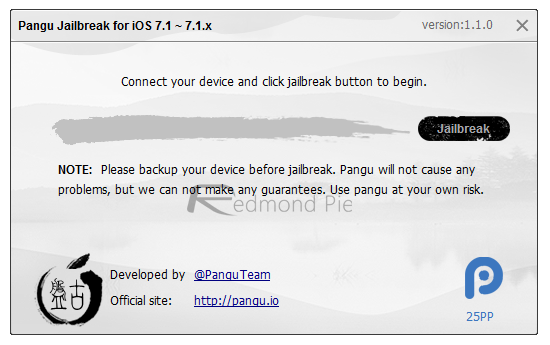
Step #5. Click on “Jailbreak” to initiate the process.
Step #6. Now, your iPhone will possibly do a reboot and you should see the Pangu icon on the homescreen. When you’re prompted to tap on it, do so.
Step #7. The jailbreak process will continue for a little while and your iPhone should go into a reboot again. Once the jailbreak finishes, you should see Cydia up on the homescreen.
Pangu was a surprising release this year and a welcome one at that. The initial tool from evad3rs could jailbreak devices running on iOS 7 and 7.0.x. When Apple released iOS 7.1, some patch was fixed and evasi0n couldn’t be used to jailbreak iOS 7.1.
Apple followed iOS 7.1 with other minor updates (resulting in iOS 7.1.1 and 7.1.2).
Pangu can jailbreak all iOS devices that run iOS 7.x (this includes iOS 7.1, 7.1.1, 7.1.2).
Pangu hasn’t been very hassle-free though. We’ve run into boot-loop issues here when we tried to jailbreak an iPhone running iOS 7.1. Most old iPhones do face a few problems when you jailbreak using Pangu but then a couple of rejailbreaks later, everything works fine.
Pangu 1.2 and 1.2.1 try to fix these little issues and quicks.
The new update comes almost right after Pangu v1.2 came out about a few days back. Both 1.2 and this one have minor changes but an important one if you’ve been having problems with boot or anything else on your iPhone.
Jailbreaking using Pangu is almost as easy as it was with evasi0n, the tool that we used to jailbreak iOS 7 and 7.0.x with.
How to Jailbreak your iPhone/iPad with Pangu 1.2.1
Step #1. Download Pangu 1.2.1 (for Windows at the moment)
Step #2. Make sure your iPhone doesn’t have a passcode.
Step #3. Change the date of your iPhone to something earlier than June 1, 2014.
Step #4. Now, connect your iPhone and run Pangu 1.2.1.
Step #5. Click on “Jailbreak” to initiate the process.
Step #6. Now, your iPhone will possibly do a reboot and you should see the Pangu icon on the homescreen. When you’re prompted to tap on it, do so.
Step #7. The jailbreak process will continue for a little while and your iPhone should go into a reboot again. Once the jailbreak finishes, you should see Cydia up on the homescreen.
Pangu was a surprising release this year and a welcome one at that. The initial tool from evad3rs could jailbreak devices running on iOS 7 and 7.0.x. When Apple released iOS 7.1, some patch was fixed and evasi0n couldn’t be used to jailbreak iOS 7.1.
Apple followed iOS 7.1 with other minor updates (resulting in iOS 7.1.1 and 7.1.2).
Pangu can jailbreak all iOS devices that run iOS 7.x (this includes iOS 7.1, 7.1.1, 7.1.2).
Pangu hasn’t been very hassle-free though. We’ve run into boot-loop issues here when we tried to jailbreak an iPhone running iOS 7.1. Most old iPhones do face a few problems when you jailbreak using Pangu but then a couple of rejailbreaks later, everything works fine.
Pangu 1.2 and 1.2.1 try to fix these little issues and quicks.
Google Patches 50 Security Vulnerabilities in Chrome Browser Update
Google has plugged 50 security vulnerabilities in the latest update to the Chrome browser.
Among the issues fixed in Chrome 37 are a number of bugs that can be used together to break out of the Chrome sandbox and execute code remotely. That discovery earned the researcher behind it a $30,000 bug bounty. Several other vulnerabilities earned researchers between $500 and $4,000.
Here are some of the bugs fixed in the update and their associated rewards:
[$30000][386988] Critical CVE-2014-3176, CVE-2014-3177: A special reward to lokihardt@asrt for a combination of bugs in V8, IPC, sync, and extensions that can lead to remote code execution outside of the sandbox.
[$2000][369860] High CVE-2014-3168: Use-after-free in SVG. Credit to cloudfuzzer.
[$2000][387389] High CVE-2014-3169: Use-after-free in DOM. Credit to Andrzej Dyjak.
[$1000][390624] High CVE-2014-3170: Extension permission dialog spoofing. Credit to Rob Wu.
[$4000][390928] High CVE-2014-3171: Use-after-free in bindings. Credit to cloudfuzzer.
[$1500][367567] Medium CVE-2014-3172: Issue related to extension debugging. Credit to Eli Grey.
[$2000][376951] Medium CVE-2014-3173: Uninitialized memory read in WebGL. Credit to jmuizelaar.
[$500][389219] Medium CVE-2014-3174: Uninitialized memory read in Web Audio. Credit to Atte Kettunen from OUSPG.
"We would also like to thank Collin Payne, Christoph Diehl, Sebastian Mauer, Atte Kettunen, and cloudfuzzer for working with us during the development cycle to prevent security bugs from ever reaching the stable channel," according to Google. "$8000 in additional rewards were issued."
Among the issues fixed in Chrome 37 are a number of bugs that can be used together to break out of the Chrome sandbox and execute code remotely. That discovery earned the researcher behind it a $30,000 bug bounty. Several other vulnerabilities earned researchers between $500 and $4,000.
Here are some of the bugs fixed in the update and their associated rewards:
[$30000][386988] Critical CVE-2014-3176, CVE-2014-3177: A special reward to lokihardt@asrt for a combination of bugs in V8, IPC, sync, and extensions that can lead to remote code execution outside of the sandbox.
[$2000][369860] High CVE-2014-3168: Use-after-free in SVG. Credit to cloudfuzzer.
[$2000][387389] High CVE-2014-3169: Use-after-free in DOM. Credit to Andrzej Dyjak.
[$1000][390624] High CVE-2014-3170: Extension permission dialog spoofing. Credit to Rob Wu.
[$4000][390928] High CVE-2014-3171: Use-after-free in bindings. Credit to cloudfuzzer.
[$1500][367567] Medium CVE-2014-3172: Issue related to extension debugging. Credit to Eli Grey.
[$2000][376951] Medium CVE-2014-3173: Uninitialized memory read in WebGL. Credit to jmuizelaar.
[$500][389219] Medium CVE-2014-3174: Uninitialized memory read in Web Audio. Credit to Atte Kettunen from OUSPG.
"We would also like to thank Collin Payne, Christoph Diehl, Sebastian Mauer, Atte Kettunen, and cloudfuzzer for working with us during the development cycle to prevent security bugs from ever reaching the stable channel," according to Google. "$8000 in additional rewards were issued."
Label:
IPhone
BetterWifi7 Cydia Tweak for iOS 7: Finest Wifi Enhancement Suite for the iPhone
There aren’t very many Wi-fi related tweaks on Cydia right now. At
first glance, it might seem normal: after all, what extra features would
the Wi-fi settings page on iPhone need? It looks and works fine (except
for a few things of course).
But here’s a tweak that changes it all. BetterWifi7 by Simon Selg is a fantastic Cydia tweak that adds some really cool features to the Wi-fi settings. The features read like a list of “oh these should have been put there by default” ones.
BetterWifi7 adds a slue of features to Settings → Wifi. They are not just visual. They’re totally functional too. Here’s a sampling of the features that caught our attention:
#1. Pull to refresh: How many times have you had to toggle the Wifi switch just to refresh the list? (your iPhone actually automatically refreshes the list frequently but more control is always nice). BetterWifi7 adds a pull to refresh feature which works just like how Mail/Stocks app do. Pull down to refresh the Wifi list.
#2. Open Networks Only: BetterWifi7 puts this toggle under Wifi settings which filters the Wifi networks around you. It shows you only the open networks so that you can pick on easily.
#3. Remove RSSI Limit: Apple sets a threshold limit (of signal strength) beneath which it won’t try to detect or connect to a Wifi signal. This switch makes sure this is bypassed. Your iPhone will search for low-strength signals too and try to connect. May cause battery issues though.
Besides these, there are few additional visual cues.
For instance, BetterWifi7 will show (under the Wifi name), the signal strength and the security mode (WPA, WEP etc.) of the Wifi networks. This is not extremely useful (the signal strength feature is) unless you’re some kind of a techie there.
Also, if you’ve connected to a network before, BetterWifi7 will keep track of all that info and remember the passwords. It also lets you copy passwords.
And there’s also a CleverPin-like auto-passcode-lock-disable feature which disables passcodes when you’re connected to a known Wifi network. (however, BetterWifi7 uses a different key to authenticate).
It’s a paid tweak but it’s well worth the $1.50 you’ll spend. The tweak is up on BigBoss repo.
Compatibility: all iOS 7.x devices
But here’s a tweak that changes it all. BetterWifi7 by Simon Selg is a fantastic Cydia tweak that adds some really cool features to the Wi-fi settings. The features read like a list of “oh these should have been put there by default” ones.
BetterWifi7 adds a slue of features to Settings → Wifi. They are not just visual. They’re totally functional too. Here’s a sampling of the features that caught our attention:
#1. Pull to refresh: How many times have you had to toggle the Wifi switch just to refresh the list? (your iPhone actually automatically refreshes the list frequently but more control is always nice). BetterWifi7 adds a pull to refresh feature which works just like how Mail/Stocks app do. Pull down to refresh the Wifi list.
#2. Open Networks Only: BetterWifi7 puts this toggle under Wifi settings which filters the Wifi networks around you. It shows you only the open networks so that you can pick on easily.
#3. Remove RSSI Limit: Apple sets a threshold limit (of signal strength) beneath which it won’t try to detect or connect to a Wifi signal. This switch makes sure this is bypassed. Your iPhone will search for low-strength signals too and try to connect. May cause battery issues though.
Besides these, there are few additional visual cues.
For instance, BetterWifi7 will show (under the Wifi name), the signal strength and the security mode (WPA, WEP etc.) of the Wifi networks. This is not extremely useful (the signal strength feature is) unless you’re some kind of a techie there.
Also, if you’ve connected to a network before, BetterWifi7 will keep track of all that info and remember the passwords. It also lets you copy passwords.
And there’s also a CleverPin-like auto-passcode-lock-disable feature which disables passcodes when you’re connected to a known Wifi network. (however, BetterWifi7 uses a different key to authenticate).
It’s a paid tweak but it’s well worth the $1.50 you’ll spend. The tweak is up on BigBoss repo.
Compatibility: all iOS 7.x devices
Label:
IPhone
iPhone Battery Drain? Here’s An App That Might Help You Get More Battery-life
Battery issues on the iPhone is a consistent pain in the
you-know-where. It’s so common, so frequent and so rampant that we find
ourselves writing about how to get more juice out of your iPhone’s
battery very frequently.
I just stumbled across this app thanks to some suggestions by a few tech-bloggers. “Normal: Battery Analytics” is an iPhone app that might help you get more battery-time on your iPhone. And it’s basically through analytics of how much resources apps consume on your iPhone.
The basic idea of Normal: Battery Analytics is to figure out what apps are eating away at your iPhone’s battery. It then suggests that you kill those apps (close them from the multi tasking switcher). But this is not all.
Normal: Battery Analytics goes way beyond telling you what apps you need to close. Read on.
In-depth Analytics of Apps
Normal’s analytics is not just about your device. It collects app-usage-stats from your iPhone and then compares it with the data it has collected from all other users who use Normal.
While not a new approach to analytics, this is probably one of the first apps to do this in the realm of battery management on iPhone.
By comparing data, Normal can tell you if that Snapchat app you use is causing battery drain on your device only or if it’s generally the case that Snapchat app causes battery issues on most users’ devices.
Doesn’t Stop with Quitting an App
Normal: Battery Analytics does not just say, “hey, this app is using up a lot of battery so quit it”. It goes on to say, “hey, I found that you use this app a lot and if you avoid it, you might save these many hours of battery every day.”
The app collects data over a period of time. It knows how much you use Facebook and with that, it pulls the average battery time consumption. And then it suggests apps that you can avoid/uninstall to enhance your iPhone’s life.
A Fabulous, Minimal Interface
Normal comes with a flat interface that’s also minimal, clean and informative. All information is also textual so there’s almost no room for confusion.
What I really like about Normal: Battery Analytics is that it is very contextual while also telling you how most other people use the apps (for comparison). Sometimes, you know if you’re using an app more than you really should (in the case of apps that are really distractions) or if you’re using an app well (in the case of apps that help you be more productive.)
We’ve suggested quitting/killing apps in the background as a battery-life enhancement tip, but it’s a blanket solution that doesn’t really tell you which app is draining your iPhone. Normal: Battery Analytics will do this for you. That’s why it gets our must-have recommendation.
I just stumbled across this app thanks to some suggestions by a few tech-bloggers. “Normal: Battery Analytics” is an iPhone app that might help you get more battery-time on your iPhone. And it’s basically through analytics of how much resources apps consume on your iPhone.
The basic idea of Normal: Battery Analytics is to figure out what apps are eating away at your iPhone’s battery. It then suggests that you kill those apps (close them from the multi tasking switcher). But this is not all.
Normal: Battery Analytics goes way beyond telling you what apps you need to close. Read on.
In-depth Analytics of Apps
Normal’s analytics is not just about your device. It collects app-usage-stats from your iPhone and then compares it with the data it has collected from all other users who use Normal.
While not a new approach to analytics, this is probably one of the first apps to do this in the realm of battery management on iPhone.
By comparing data, Normal can tell you if that Snapchat app you use is causing battery drain on your device only or if it’s generally the case that Snapchat app causes battery issues on most users’ devices.
Doesn’t Stop with Quitting an App
Normal: Battery Analytics does not just say, “hey, this app is using up a lot of battery so quit it”. It goes on to say, “hey, I found that you use this app a lot and if you avoid it, you might save these many hours of battery every day.”
The app collects data over a period of time. It knows how much you use Facebook and with that, it pulls the average battery time consumption. And then it suggests apps that you can avoid/uninstall to enhance your iPhone’s life.
A Fabulous, Minimal Interface
Normal comes with a flat interface that’s also minimal, clean and informative. All information is also textual so there’s almost no room for confusion.
What I really like about Normal: Battery Analytics is that it is very contextual while also telling you how most other people use the apps (for comparison). Sometimes, you know if you’re using an app more than you really should (in the case of apps that are really distractions) or if you’re using an app well (in the case of apps that help you be more productive.)
We’ve suggested quitting/killing apps in the background as a battery-life enhancement tip, but it’s a blanket solution that doesn’t really tell you which app is draining your iPhone. Normal: Battery Analytics will do this for you. That’s why it gets our must-have recommendation.
Label:
IPhone
Best Cydia Sources/Repos of 2014 for iOS 7.x Tweaks and Mods
The best way to discover cool Cydia tweaks, themes, mods and get
troubleshooting help is through the community. The jailbreak community
is spread over a vast area, with some really awesome forums being hosted
by popular websites.
If you’re looking to jailbreak your iPhone/iPad, there’s Pangu for IOS 7.x . Here’s a list of the most popular and most useful iOS 7 Cydia repos / sources of 2014.
Best Cydia Sources/Repos for iOS 7.x
Repo: BigBoss
Source: http://apt.thebigboss.org/mobileweb/index.php
BigBoss is the single largest source of most popular tweaks. You’ll find most of the popular iOS 7 tweaks showing up on BigBoss. Developers submit their tweaks here to reach a wide audience. The tweaks in BigBoss are usually checked for inconsistencies etc. This comes as a default repo with Cydia but you can remove it. Well, removing it doesn’t make any sense though.
Repo: ModMyi
Source: http://apt.modmyi.com/
Right next to BigBoss, it’s ModMyi (although some folks would argue the opposite). ModMyi hosts a lot of tweaks too, many of them insanely popular. ModMyi also comes with a lot of mods too although it would be less interesting than the tweaks themselves.
Repo: Rpetri.ch
Source: http://rpetri.ch/repo/
Ryan Petrich is a lead developer when it comes to intelligent, smart and ingenious tweaks. He is the guy behind tweaks like Activator, DisplayRecorder, BrowserChooser. We hear he’s got a lot of new stuff on the works for iOS 7 and it would be pretty interesting to test them out. This is a must-have repo for everyone interested in Cydia tweaks.
Repo: iSpazio
Source: http://repo.ispazio.net
iSpazio is a good source for tweaks, mods and other things. As the community develops compatibility and stability for iOS 7 tweaks, I expect iSpazio to feature new tweaks and mods that would work on iOS 7 devices.
Rogue Repos
Besides the genuine ones, there are also other repos which feature cracked versions of the tweaks. It’s piracy and we don’t support it. But in certain cases like HackYouriPhone, we’ve had the chance to download some interesting tweaks and mods that are not available elsewhere. Proceed with caution.
Repo: Insanlyi.com
Source: http://repo.insanelyi.com
Features: tweaks, mods
Repo: BiteYourApple
Source: http://repo.biteyourapple.net
Features: tweaks, mods
Repo: HackYouriPhone
Source: http://repo.hackyouriphone.org
Features: tweaks, ringtones, mods
If you’re looking to jailbreak your iPhone/iPad, there’s Pangu for IOS 7.x . Here’s a list of the most popular and most useful iOS 7 Cydia repos / sources of 2014.
Best Cydia Sources/Repos for iOS 7.x
Repo: BigBoss
Source: http://apt.thebigboss.org/mobileweb/index.php
BigBoss is the single largest source of most popular tweaks. You’ll find most of the popular iOS 7 tweaks showing up on BigBoss. Developers submit their tweaks here to reach a wide audience. The tweaks in BigBoss are usually checked for inconsistencies etc. This comes as a default repo with Cydia but you can remove it. Well, removing it doesn’t make any sense though.
Repo: ModMyi
Source: http://apt.modmyi.com/
Right next to BigBoss, it’s ModMyi (although some folks would argue the opposite). ModMyi hosts a lot of tweaks too, many of them insanely popular. ModMyi also comes with a lot of mods too although it would be less interesting than the tweaks themselves.
Repo: Rpetri.ch
Source: http://rpetri.ch/repo/
Ryan Petrich is a lead developer when it comes to intelligent, smart and ingenious tweaks. He is the guy behind tweaks like Activator, DisplayRecorder, BrowserChooser. We hear he’s got a lot of new stuff on the works for iOS 7 and it would be pretty interesting to test them out. This is a must-have repo for everyone interested in Cydia tweaks.
Repo: iSpazio
Source: http://repo.ispazio.net
iSpazio is a good source for tweaks, mods and other things. As the community develops compatibility and stability for iOS 7 tweaks, I expect iSpazio to feature new tweaks and mods that would work on iOS 7 devices.
Rogue Repos
Besides the genuine ones, there are also other repos which feature cracked versions of the tweaks. It’s piracy and we don’t support it. But in certain cases like HackYouriPhone, we’ve had the chance to download some interesting tweaks and mods that are not available elsewhere. Proceed with caution.
Repo: Insanlyi.com
Source: http://repo.insanelyi.com
Features: tweaks, mods
Repo: BiteYourApple
Source: http://repo.biteyourapple.net
Features: tweaks, mods
Repo: HackYouriPhone
Source: http://repo.hackyouriphone.org
Features: tweaks, ringtones, mods
Monday, 4 August 2014
iOS 7.1 / 7.1.1 / 7.1.2 Untethered Jailbreak Released
Pangu jailbreak available for Windows and Mac can jailbreak all devices
on the latest Apple iOS firmware version. If you are looking to
jailbreak your device using Pangu, simply follow the tutorial linked
above to jailbreak iOS 7.1 or iOS 7.1.2 on any iPhone, iPad and iPod
touch.
Compatible devices:
In March, Apple released iOS 7.1 in which Evasi0n7 untethered jailbreaking tool, as expected, was patched by the Cupertino-based company.
Later in the same month, Winocm posted a video on YouTube demonstrating iOS 7.1 untethered boot on an A4-based iPhone 4. No time frame was given for its release. This was immediately followed by iH8sn0w who claimed on Twitter that his iPhone 4s is jailbroken on iOS 7.1. But details, as usual, were scarce, and it was unknown on when the actual jailbreak will be made available to the public.
iOS 7.1.1 was released in April. In May, i0n1c, Winocm and Yeongjin all managed to jailbreak iOS 7.1.1 independently. i0n1c’s one was called Cyberelevat0r. There was still no word on public ETA from any of them.
In June, out of no where, a team of Chinese developers released Pangu iOS 7.1.1 untethered jailbreak which worked on all devices.
i0n1c claimed that the exploits used in Pangu jailbreak were actually stolen from him from folks who took one of his training classes early in the year.
Source : redmondpie.com
Compatible devices:
- iPhone 5s
- iPhone 5c
- iPhone 5
- iPhone 4s
- iPhone 4
- iPad Air
- Retina iPad mini
- iPad mini
- iPad 4, 3, 2
- iPod touch 5
- iOS 7.1.2
- iOS 7.1.1
- iOS 7.1
In March, Apple released iOS 7.1 in which Evasi0n7 untethered jailbreaking tool, as expected, was patched by the Cupertino-based company.
Later in the same month, Winocm posted a video on YouTube demonstrating iOS 7.1 untethered boot on an A4-based iPhone 4. No time frame was given for its release. This was immediately followed by iH8sn0w who claimed on Twitter that his iPhone 4s is jailbroken on iOS 7.1. But details, as usual, were scarce, and it was unknown on when the actual jailbreak will be made available to the public.
iOS 7.1.1 was released in April. In May, i0n1c, Winocm and Yeongjin all managed to jailbreak iOS 7.1.1 independently. i0n1c’s one was called Cyberelevat0r. There was still no word on public ETA from any of them.
In June, out of no where, a team of Chinese developers released Pangu iOS 7.1.1 untethered jailbreak which worked on all devices.
i0n1c claimed that the exploits used in Pangu jailbreak were actually stolen from him from folks who took one of his training classes early in the year.
On June 30th, Apple released a bug fix iOS 7.1.2 update which didn’t
patched the exploits used in Pangu jailbreak. The developers behind
Pangu updated the software for both Windows and Mac with full support
for iOS 7.1.2 untethered jailbreak on all the iOS devices.
Source : redmondpie.com
Subscribe to:
Posts (Atom)